
Premack’s Principle: Why Pairing Non-Preferred Tasks with High-Value Reinforcers Eliminates Transition Refusal
In applied behavioral analysis (ABA) and developmental psychology, Premack’s Principle states that an opportunity to engage in a high-probability behavior (a preferred activity such as playing with sensory sand or watching a preferred video) can effectively reinforce a low-probability behavior (a non-preferred task such as putting away shoes, sitting for circle time, or completing a math worksheet).
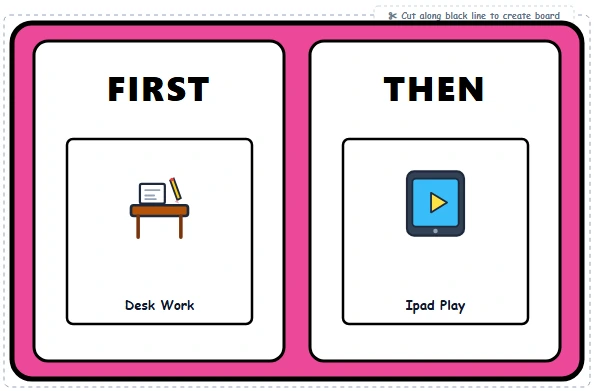
The First-Then Board is the physical, externalized embodiment of this principle. By translating an abstract verbal contingency into an unshakeable visual reality, the learner is not forced to rely on fleeting auditory memory or interpret emotional inflections in an adult's voice. The green FIRST card establishes the clear boundary of the demand, while the blue THEN card provides undeniable proof that the preferred activity is guaranteed upon task completion.
Why Verbal Prompts Fail During Overload
When a neurodivergent child experiences sensory overload, anxiety, or cognitive fatigue, the auditory processing centers of the brain degrade first. Repeated verbal prompts—even delivered with warmth and patience—are perceived as acoustic clutter. This causes cognitive overload, triggers a fight-or-flight response, and leads directly to meltdowns or refusal.
Why Visual Schedules De-escalate
Visual schedules remain static in physical space. A child can reference a First-Then card repeatedly without social pressure. The adult steps out of the role of the authoritarian taskmaster and becomes a supportive facilitator pointing to the board: "Look, the board says first puzzle, then swings." The schedule becomes the neutral authority.
Step-by-Step Implementation in the Classroom and Home
Establish the Contingency Before the Transition Occurs
Never introduce a First-Then board in the middle of a high-intensity crisis. Present the board 2 minutes before the expected transition: "In two minutes, First Wash Hands, Then iPad." Allow the learner to hold or touch the board.
Match the Reinforcer to the Current Motivational State
A common pitfall is using a reinforcer that was motivating yesterday but holds no value today. Offer the learner a choice of two preferred icons for the THEN card prior to beginning the FIRST task.
Immediate, Unconditional Delivery of Reinforcement
The exact second the FIRST task is finished, transition immediately to the THEN activity. Do not tack on surprise secondary demands. If you promised swings after putting on shoes, going to the swings must occur immediately to maintain instructional credibility.
Scaffolding Beyond 2-Step Contingencies
While the First-Then board is the gold standard for acute transitions and behavioral compliance, learners naturally progress as their task endurance grows. Once your student masters single-demand completion, scaffold them into a 3-Step Sequence Schedule (First-Next-Then) to build working memory stamina, or organize their entire morning and evening with a multi-task Daily Routine Strip.
Classroom Fabrication & Sensory Durability Standards
Children with autism and sensory processing differences frequently mouth, bend, or peel visual cards. To ensure your printed First-Then board withstands daily clinical or classroom rigor:
- Cardstock Weight: Print on 65lb to 110lb cardstock rather than 20lb copy paper to eliminate flimsy bending.
- Thermal Lamination: Utilize 5mil or 7mil thermal pouches. 3mil pouches peel rapidly at the edges when subjected to repeated Velcro detachment.
- Universal Velcro Rule: Adhere rough hook coins to the board surface and soft loop coins to the back of cards. This prevents loose cards from snagging on rugs, clothing, or hair.
- Safety Corner Punching: Standard laminated corners are razor-sharp. Use a 4mm corner rounder punch to remove all sharp tips.
Frequently Asked Questions: First-Then Boards
Clinical guidance for teachers, speech therapists, and caregivers.
What is a First-Then visual schedule and why is it effective?
A First-Then board is a foundational behavioral support tool based on Premack's Principle (often called 'Grandma's Rule'). By visually arranging a low-probability, non-preferred task on the green 'FIRST' card and a high-probability preferred activity on the blue 'THEN' card, children with autism, ADHD, and language delays can clearly anticipate what is required before accessing reinforcement. Visual schedules externalize working memory demands and drastically decrease transition resistance.
How does a First-Then board prevent transition refusal and behavioral meltdowns?
During times of stress, transition, or auditory processing overload, verbal instructions ('Clean up your toys, then we can have a snack') are often perceived as invasive noise or cognitive pressure. A visual First-Then board replaces repeated verbal prompting with an objective, neutral visual cue. The learner sees that the non-preferred task has a clear boundary and that reward is guaranteed immediately upon completion.
What size are the printable First-Then cards?
Cards generated by MyRoutineBoard are mathematically calibrated to exactly 2"×2" (50.8mm × 50.8mm). This universal standard allows you to seamlessly attach standard 0.5" to 0.75" adhesive hook-and-loop (Velcro) dots and swap them directly into standard classroom schedule strips, PECS binders, and pocket charts.
Can I use real photographs for non-preferred tasks and preferred rewards?
Yes! Real photos of your student's actual classroom desk, speech therapy room, or favorite sensory swing make the Premack contingency unmistakable for early visual learners who have not yet generalized vector icons. All photo processing happens client-side with zero cloud uploads.
Why should the 'First' card be physically removed immediately after completion?
In applied behavioral science, removing the 'First' card provides a concrete visual signal that the demand has ceased (demand extinction). Handing the card to an adult or placing it in an 'All Done' container physically marks closure, instantly bridging the learner to their 'Then' reward.
When should I transition from a First-Then board to a 3-step sequence?
Once the learner consistently completes the 'First' demand with minimal prompting and demonstrates an understanding that the board reliably predicts the future, you can scaffold to a 3-step schedule (First-Next-Then). This expands their working memory capacity without triggering anxiety.