
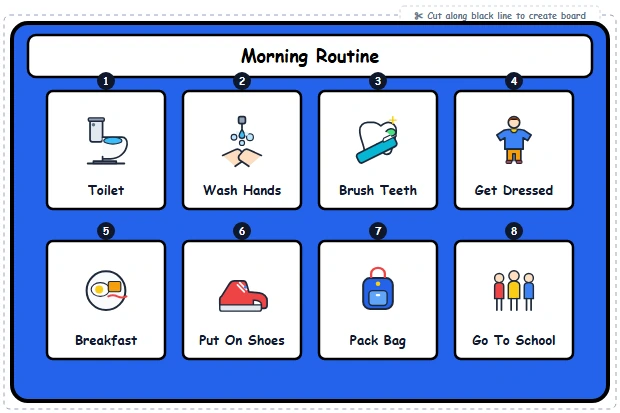
The Power of Visual Task Strips: Replacing Nagging with Environmental Automation
Morning and bedtime routines are the most frequent triggers of family stress and behavioral resistance. For neurodivergent children, transitioning between sleep, personal hygiene, dressing, and school departure involves complex executive functioning demands: initiation, inhibition, sequencing, and sustained attention.
When parents rely on verbal prompting, each reminder is processed as a separate cognitive interruption. This creates prompt dependency (where the child does not move unless verbally directed) and fuels relationship friction. A physical routine strip transfers authority from the parent's voice to an objective environmental checklist.
Forward Chaining Method
Teach Step 1 (e.g., Toilet). Once the child completes Step 1 independently, reward them immediately and assist with the rest. Gradually require independent completion of Steps 1 and 2, then Steps 1, 2, and 3, building sustained momentum.
The Tactile 'All Done' Pocket
The tactile feedback of pulling a Velcro card off the board and dropping it into an 'All Done' container provides physical completion cues that trigger dopamine release, keeping children engaged without requiring digital screens.
Step-by-Step Implementation in the Classroom and Home
Anchor the Strip in the Functional Environment
Mount your visual strip at the child's exact eye level directly where the routine takes place—such as bathroom mirrors for hygiene, or next to the closet for morning dressing. Do not keep routine strips tucked in drawers.
Replace Verbal Prompts with Gestural Pointing
When the child pauses or wanders, resist the urge to repeat verbal commands. Walk calmly over to the strip, point silently to the active task card, and ask gently: "What does your board say?" This shifts executive control to the physical tool.
Reinforce Immediate Task Closure with the 'All Done' Box
As soon as an activity like brushing teeth concludes, prompt the learner to pull the card off its Velcro fastener and deposit it into the 'All Done' container. Celebrating the physical depletion of the strip creates tangible pride in daily routines.
Connecting Routine Strips with Micro-Task Supports
If your learner struggles with acute transition resistance when initiating the routine strip, pair the sequence with an introductory First-Then Board. For complex hygiene steps within your routine (such as 6-step handwashing or potty training), mount a dedicated Task Analysis Strip right above the sink, or carry portable 2"×2" Lanyard Cue Cards for transitions outside the home.
Classroom Fabrication & Sensory Durability Standards
Daily routine strips undergo aggressive physical peel-and-stick actions twice daily. To build a classroom-grade strip:
- Cardstock Weight: Print on 80lb–110lb cardstock for rigid strip stability and tear resistance.
- Heavy Lamination: Use 5mil or 7mil thermal pouches. Seal edges with a 1/8" border before final trimming.
- Hook & Loop Discipline: Mount rough hook coins on the backing strip and soft loop coins on the cards to prevent clothing snags.
- Corner Safety: Round all strip and card corners with a 4mm corner rounder punch to remove jagged lamination points.
Frequently Asked Questions: Routine Strips
Clinical guidance for teachers, speech therapists, and caregivers.
How does a visual routine strip foster morning and bedtime independence?
A visual routine strip externalizes the sequential daily tasks (such as toilet, wash hands, brush teeth, dress, backpack) into an objective, physical checklist. Instead of a parent or teacher giving repetitive verbal reminders ('Did you brush your teeth? Put your shoes on!'), the child learns to check the board independently. This eliminates power struggles and establishes habitual automaticity.
Should I choose a horizontal or vertical routine strip orientation?
Horizontal strips mirror standard Western reading and writing orientation (left-to-right), making them ideal for reinforcing emergent literacy and chronological progression. Vertical strips mirror top-to-bottom gravity and checklist progression, which is often preferred for narrow physical spaces (such as bathroom mirrors, refrigerator doors, or next to bedroom closets).
How many steps should be included on a daily routine strip?
Developmental research suggests 4 to 6 steps is the optimal window for children aged 3 to 10. Fewer than 4 steps often fails to capture the full hygiene sequence, while more than 7 steps causes visual clutter and cognitive fatigue. Our generator allows you to expand or contract between 3 and 7 steps.
What is the 'All Done' pocket method?
The 'All Done' pocket is a laminated envelope or pouch adhered to the end of the routine strip. When a child completes Step 1, they physically pull the card off the Velcro dot and deposit it into the pocket. Seeing the board empty step-by-step provides immense intrinsic visual and tactile satisfaction.
Can I use real photographs of our bathroom, bedroom, or clothing?
Yes! Click any card to open the pictogram modal, then select 'Upload Photo' to snap or upload photos from your smartphone. Photos are rendered entirely in your device's browser with zero cloud storage, ensuring full family and student privacy.
Should I cut out individual routine cards or leave the strip as a single wall checklist?
Both work well depending on fine-motor goals. If using Velcro coins, cut each 2"×2" card so the child physically moves cards to an 'All Done' pocket upon task completion. If you want a static bathroom mirror checklist, print the complete sheet as a single laminated poster and use dry-erase markers to check off steps.