
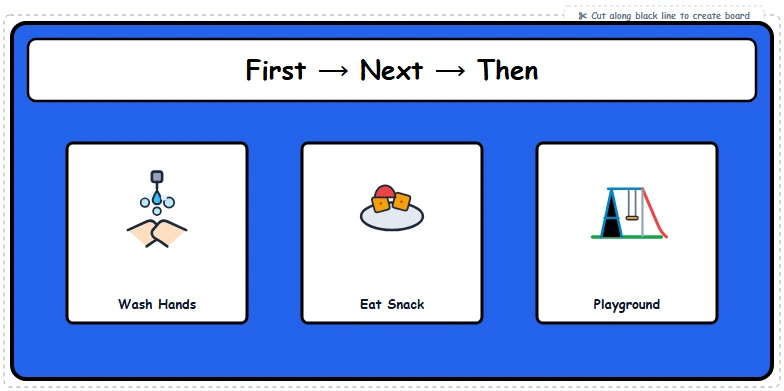
Scaffolding Working Memory: The Cognitive Transition from Binary Pairs to 3-Step Sequences
While a 2-box First-Then board is the gold standard for acute transition refusal, it presents a functional limitation: real-world school and home environments require sustained task tolerance across multiple sequential activities before access to primary reinforcement.
The 3-Step Sequence Schedule provides the crucial developmental stepping stone. In neuropsychology, working memory refers to the cognitive system responsible for temporarily holding and manipulating information for complex tasks like reasoning and comprehension. For children with ADHD, autism spectrum disorder, or developmental delays, the central executive processor experiences cognitive decay after approximately 1 to 2 discrete demands. By visually displaying First · Next · Then, you externalize the working memory buffer onto a physical board, dramatically reducing cognitive fatigue.
First · Next · Then (Contingency Mode)
Use when the child needs explicit reinforcement motivation. The structure pairs two low-to-moderate demand tasks (e.g., Wash Hands → Clean Desk) with an ultimate high-value reward (Then: Recess). It trains delayed gratification and task perseverance.
Now · Next · Later (Predictability Mode)
Use for temporal orientation and time-blindness without behavioral contingencies. For anxious learners who repeatedly ask "What are we doing next?", this provides reassuring certainty about what is happening immediately, what follows, and what will happen in the future.
Clinical Guidance: Implementing Backward Chaining
When introducing a 3-step board to a learner struggling with task endurance, occupational therapists recommend Backward Chaining:
Connecting Sequential Schedules to Classroom Routines
If your learner is still overwhelmed by 3 steps or experiences sudden resistance on Step 2, regress temporarily to our simple First-Then Board (2-Step Transition). Conversely, once 3-step sequences become automatic, transition your learner to our 5-step Daily Routine Strip to encompass full morning, hygiene, and classroom subject schedules.
Classroom Fabrication & Sensory Durability Standards
3-step sequence boards endure frequent hands-on manipulation as cards are rotated throughout the day. To ensure long-lasting durability:
- Cardstock Weight: Print on 65lb to 110lb cardstock rather than standard copy paper to prevent creasing during frequent card handling.
- Thermal Lamination: Utilize 5mil or 7mil thermal pouches to withstand repeated peel-off cycles without edge fraying.
- Velcro Standard: Adhere rough hook coins to the three board frames and soft loop coins to the backs of 2"×2" cards to prevent snagging.
- Corner Rounding: Use a 4mm corner rounder punch on all cut cards and schedule boards to protect young learners from sharp edges.
Frequently Asked Questions: 3-Step Sequences
Clinical guidance for teachers, speech therapists, and caregivers.
When should a child move from a 2-box First-Then board to a 3-step schedule?
A child is ready for a 3-step schedule (First-Next-Then) when they reliably follow 2-step contingencies without emotional resistance and demonstrate an understanding of chronological sequence. Moving to 3 steps bridges the cognitive gap between simple binary task-to-reward pairing and multi-step independent classroom or morning routines.
What is the clinical difference between 'First · Next · Then' and 'Now · Next · Later'?
'First · Next · Then' is an explicit behavioral contingency sequence where Step 3 ('Then') serves as the primary conditioned reinforcer following two successive demands. In contrast, 'Now · Next · Later' is an environmental predictability schedule designed to anchor temporal orientation and alleviate time-blindness or schedule anxiety without implying a conditional behavioral contract.
How does a 3-step schedule prevent cognitive fatigue in ADHD and autism?
Individuals with ADHD, autism, and executive dysfunction often struggle with working memory decay—the mental energy required to hold multi-step instructions in mind while performing physical tasks. A 3-step visual schedule externalizes the executive sequence, eliminating the mental load of wondering 'What do I do after this?' and preventing attention drift.
Are the cards on this board sized for standard pocket charts and Velcro?
Yes! All printable cards generated by MyRoutineBoard are mathematically calibrated to exactly 2"×2" (50.8mm × 50.8mm). They fit standard 0.5" to 0.75" adhesive Velcro coins, standard classroom pocket charts, and lanyard rings.
Can I swap the card order or change the text capitalization?
Yes. You can click the arrow buttons (← →) on any card to reorder tasks immediately, and use the sidebar options to toggle between uppercase, title case, sentence case, or lowercase text depending on whether you are teaching letter case recognition to emergent readers.
What font is best for autistic or dyslexic learners on a 3-step schedule?
We offer Manuscript (ABeeZee font, featuring single-story 'a' and 'g' identical to early handwriting instruction) and Dyslexic (OpenDyslexic font, featuring weighted gravity baselines to eliminate letter inversion and visual rotation). For neurotypical early readers, Manuscript provides maximum character recognition.