
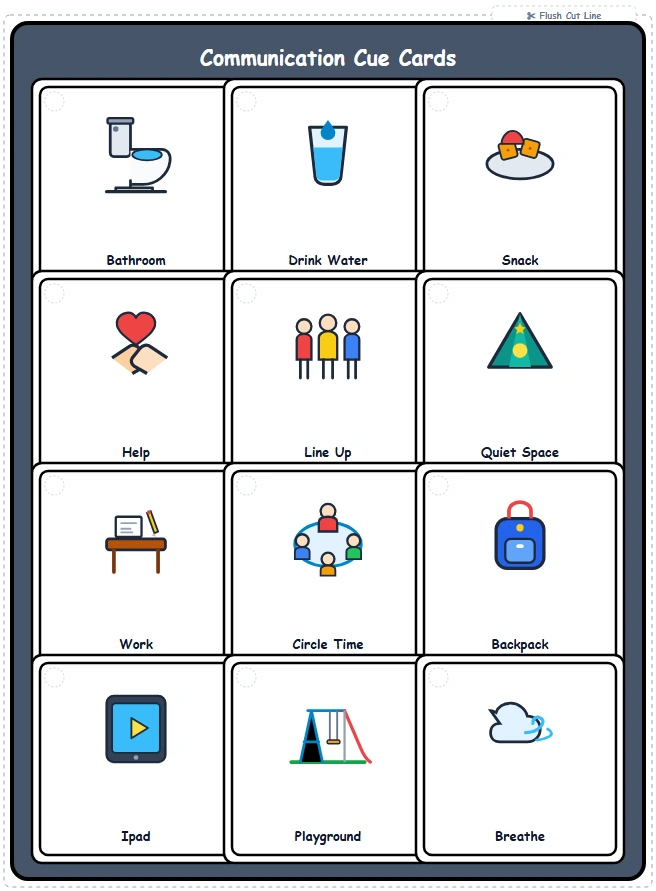
On-The-Go Redirection: Why Wearable Lanyard Cue Cards Transform Classroom Transitions
While stationary visual schedules anchor designated areas like desks or bathroom mirrors, behavioral challenges frequently occur in high-traffic, unstructured transition zones: crowded hallways, noisy cafeterias, sensory-rich school buses, and outdoor playgrounds.
A wearable ring of 2"×2" laminated cue cards allows paraprofessionals, special education teachers, and parents to provide immediate, non-verbal visual redirection without raising their voice or escalating auditory anxiety.
Step-by-Step Implementation Protocol for Paraprofessionals & Therapists
Organize Cards by Frequency & Urgency
Place urgent redirection symbols (such as "Stop", "Walk", "Wait", "Quiet Hands") at the front of your ring, followed by functional communication requests ("Bathroom", "Water", "Break", "Help").
Deliver Silent Visual Cues
In a loud hallway or cafeteria, verbal commands like "Stop running!" add to acoustic chaos. Step calmly into the child's line of vision and silently hold up the "Walk" or "Stop" card. Visual cues bypass auditory filters and trigger faster compliance.
Reinforce Prompt Compliance Immediately
The instant the student complies with the visual card, provide a brief positive confirmation (thumbs up or a quick whisper) and lower the card. Keep interactions calm, predictable, and supportive.
Integrating Cue Cards with Classroom Schedule Systems
Because our cue cards are calibrated to standard 2"×2" dimensions, they double as replacement task cards across all your static classroom tools! Attach Velcro dots to the backs to swap them seamlessly into a stationary Daily Routine Strip, or pull two cards off your ring to form an ad-hoc First-Then Board during unexpected schedule interruptions.
How to Fabricate Professional Lanyard Rings
- Print: Print the sheet on 80lb–110lb cardstock for structural integrity and opacity.
- Laminate: Encase the entire sheet in a 5mil or 7mil thermal laminating pouch before cutting.
- Trim: Cut along the dashed 0.5pt guide lines using a rotary paper cutter or sharp scissors.
- Punch Hole & Round Corners: Punch the 0.2" circular guide mark on each card. Use a 4mm corner rounder punch to remove all sharp tips.
- Ring Assembly: Thread cards onto a 1.25" metal book ring attached to a breakaway safety lanyard.
Frequently Asked Questions: Cue Cards
Clinical guidance for teachers, speech therapists, and caregivers.
Why is 2"×2" the universal standard for visual cue cards?
The 2"×2" (50.8mm × 50.8mm) form factor is the worldwide benchmark across special education, Picture Exchange Communication Systems (PECS), standard tabletop schedule strips, and commercial vinyl pocket charts. At this exact dimension, symbols are large enough for emergent readers to discern fine details while remaining compact enough to carry 15–20 cards comfortably on a single educator lanyard ring.
How do portable lanyard rings support transitions during recess, cafeteria, and field trips?
Most behavioral escalations and elopement incidents happen outside structured classrooms—in chaotic, noisy environments like playgrounds, school hallways, cafeteria lunch lines, and school busses. An educator wearing a curated ring of lanyard cue cards can provide instantaneous non-verbal visual redirection ('Quiet Voice', 'Walk', 'Stop', 'Help') without yelling across a crowded space.
How do visual cue cards assist non-speaking learners during emotional dysregulation?
When an individual experiences sensory overload, meltdowns, or intense fight-or-flight arousal, vocal speech production centers in the brain often shut down completely (situational mutism). Lanyard cue cards provide immediate, zero-effort AAC (Augmentative and Alternative Communication) access, allowing the learner to point to 'Break', 'Water', 'Bathroom', or 'Too Loud'.
What is the purpose of the dashed lanyard hole guide markers?
Our generator places a subtle 0.2" dashed circular guide in the top-left corner of each card. After printing and laminating, this marker ensures every card is punched at the exact same uniform offset, preventing cards from binding, tearing, or hanging crookedly on your metal split ring.
What hardware should I use for fabricating lanyard cue rings?
We recommend a safety breakaway lanyard (which snaps open under tension to prevent strangulation hazards), a 1.25" to 1.5" metal hinged book ring or stainless steel cable ring, 5mil thermal laminating pouches, and a 4mm corner rounder punch.
Can I print on standard US Letter or European A4 paper?
Yes. Use the Paper Format selector to choose US Letter (8.5×11") or A4 (210×297mm). Our calibration math automatically centers the 12-card grid (3×4 portrait or 4×3 landscape) while preserving true 50.8mm physical dimensions.